

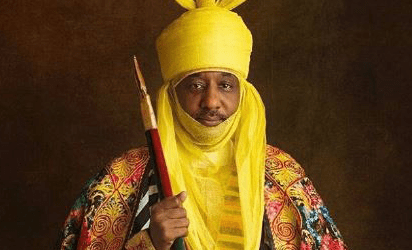
Emir Sanusi, urges universities to lead Nigeria’s AI strategy, strengthen role in democracy
Kola Oyelere Kano
Read also: Demolition:Emir Sanusi visits Rimin Zakara, calls for calm over land dispute
The Emir of Kano, Muhammad Sanusi II, has called on Nigerian universities to take the lead in developing a comprehensive national strategy on artificial intelligence (AI), warning that the country risks falling behind without a coordinated policy framework.
Speaking at the opening of the 8th Biennial Conference of the Committee of Pro-Chancellors of State Universities in Nigeria (COPSUN), attended by pro-chancellors, vice-chancellors and registrars of state-owned universities in Kano, the monarch stressed the importance of university leadership in shaping policy direction and improving governance within the higher education system.
Sanusi commended state governments for recognising the critical role of pro-chancellors in setting policy and overseeing university administration, noting that their leadership is central to enhancing the quality of education.
He observed that universities are gradually returning to their core mandate of conducting high-quality research capable of fostering a resilient and self-reliant nation. However, he emphasised that institutions must also reclaim their place as a vital component of civil society.
“Without intellectuals and academic freedom, the checks and balances necessary to keep political institutions accountable will disappear,” he said,
urging academics to contribute more actively to national debates on democracy, the economy, science, and technological development.
Highlighting global trends, the Emir referenced Ghana’s recently launched national AI strategy, which includes plans to train one million young people and establish a continental hub for artificial intelligence. He described this as a challenge Nigeria must respond to with urgency.
According to him, Nigerian universities should move beyond isolated institutional efforts and work collectively to design a national framework that prepares the country for emerging technological realities.
“This country needs a strategy. It needs a policy framework. It must be ready for the century we are in,” he said.
Sanusi further urged university leaders to balance their responsibility of producing skilled graduates with a broader national duty to contribute to policy development and strategic planning.
Speaking of the occasion,the
Executive Chairman of the Economic and Financial Crimes Commission (EFCC), Olanipekun Olukoyede, called for the integration of artificial intelligence (AI) into the governance and financial management systems of Nigerian universities to address persistent cases of fraud and inefficiency.
Read also: CHRICED Marks 20 Years, Unveils Civic Centre in Kano
He described the academic community as a critical driver of national development, stressing that no country can achieve sustainable growth without a strong intellectual base.
According to him, the adoption of AI in university systems is no longer optional but inevitable, given the scale of financial operations in tertiary institutions.
The EFCC chairman noted that universities manage billions of naira in tuition, grants, and intervention funds, yet accountability challenges remain widespread.
He disclosed that the commission has investigated several cases involving inflated contracts, ghost workers, and diversion of funds within the university system.
He explained that AI-powered tools could flag suspicious transactions in real time, detect duplicate payments, and identify irregular salary structures, thereby preventing financial leakages.
He cited an instance uncovered by the EFCC in which a university was paying salaries far above its actual staff strength, describing it as a result of systemic weaknesses and lack of technological oversight.
The EFCC chairman also highlighted the commission’s use of AI in its operations, referencing a major crackdown on a cybercrime syndicate in Lagos in December 2024.
According to him, AI tools enabled investigators to analyse large volumes of data, leading to the arrest of 792 suspects, including foreign nationals involved in cryptocurrency fraud and online scams.
He cautioned, that AI is not a complete solution and must be complemented by human oversight and institutional integrity.
“Technology will not work magic where there is an integrity deficit,” he said.
In a goodwill message delivered on behalf of Kano State Governor Abba Kabir Yusuf, the Chief of Staff, Dr Suleiman Wali Sani, reaffirmed the state government’s commitment to education as a tool for socio-economic transformation.
He outlined ongoing investments in infrastructure, staff development, and digital learning across state-owned tertiary institutions.
Read also: CITAD warns against suppressing peaceful labour agitations
While the Chairman of COPSUN, Prof. Ayodeji Omole, emphasised the importance of collaboration among university governing councils to address common challenges such as funding constraints, infrastructural deficits, and technological transformation.
The conference brought together pro-chancellors, vice-chancellors, policymakers, and other stakeholders to deliberate on the role of artificial intelligence in strengthening governance, accountability, and innovation in Nigeria’s university system.