



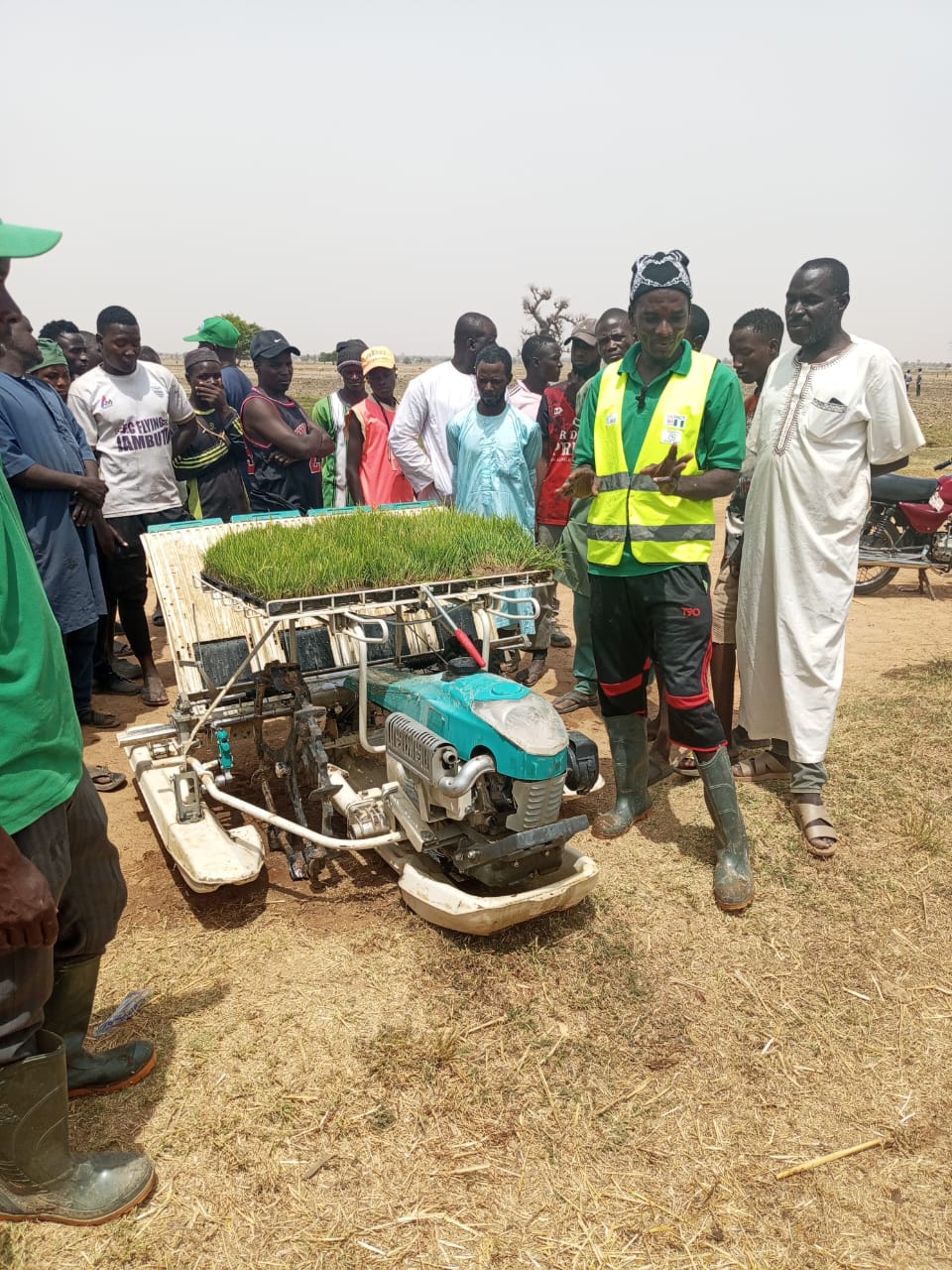
SRI-2030 trains Kano farmers on modern rice transplanting
Rice farmers in Kano State have received training on modern transplanting techniques under the System of Rice Intensification (SRI-2030) initiative, aimed at improving productivity and reducing labour costs.
Read also: 50 APC supporters defect to NNPP in Kibiya, Kano
The training, conducted in collaboration with Propcom Plus, took place in Katarkawa community, Warawa Local Government Area, and featured practical demonstrations on machine-based transplanting methods.
SRI-2030 Nigeria Consultant and Master Trainer, Abdul-Rahman Danbaba, said the programme was part of efforts to scale up SRI practices nationwide through partnerships with rice millers and other stakeholders.
He noted that participants were also provided with reference materials in Hausa to enhance understanding and encourage adoption of the improved techniques.
Danbaba explained that the training was designed to equip farmers with practical skills in modern rice production and enable them to serve as service providers within their communities. He, however, identified limited access to transplanting machines as a major challenge.
“Many farmers have been trained on the use of transplanting machines but cannot afford them due to the high cost. We are calling on development partners to support them with the equipment,” he said.
He added that SRI-2030 and Propcom Plus are working with rice millers in other parts of the country, including FalGates Rice in Adamawa State, where about 600 farmers are supported with inputs such as fertilisers and solar irrigation pumps under a repayment arrangement.
In Kano and Jigawa states, he said the programme is supporting about 298 farmers cultivating over 330 hectares in partnership with Fursa Rice.
Read also: Kano to pursue ‘what is due’ under Federal character — SSG
During the demonstration, field officer Abubakar Abdulrahman described mechanical transplanting as a time-saving and labour-efficient innovation.
He said while manual transplanting requires about 20 workers over two days to cover one hectare, the machine enables two to three people to complete the same task within three hours.
Abdulrahman explained that the method involves the use of a specialised “mat nursery” prepared with sandy soil, rice bran, and organic manure, as well as proper field preparation and machine calibration.
He added that the cost of machine transplanting is about N50,000 per hectare, compared to between N80,000 and N100,000 for manual labour.
A beneficiary, Zainab Bashari, said the innovation had significantly reduced the burden and cost of transplanting.
“Before now, we spent two to three days and up to N100,000 on labour for one hectare. With the machine, the work is faster, cheaper, and less stressful,” she said.
Bashari, a widow and mother of 10, said the training had improved farming practices and yields, with harvests ranging between 40 and 45 bags per hectare, and up to 100 bags in favourable conditions.
She, however, appealed for support in the form of fertilisers, irrigation pumps, and transplanting machines to enable farmers expand production.
The SRI-2030, in collaboration with the Federal Ministry of Agriculture and Food Security, had earlier trained 22 extension workers in January 2024 on sustainable rice farming and climate change mitigation across five states.
The training was part of broader efforts to promote environmentally friendly rice production methods that enhance yield while reducing greenhouse gas emissions.


