


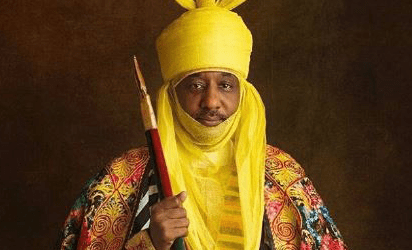
Nentawe’s Visit to Sanusi: A Rejoinder to a Misconceived Political Narrative
**By **
Read also: APC’s growing political strength puts Kwankwaso’s Kano dominance to test in 2027
Dr. Usman M. Umar
The recent commentary titled “Nentawe’s Visit to Sanusi: A Political Miscalculation That Could Cost APC Kano in 2027” by one Aliyu Dalhatu presents a dramatic conclusion built largely on assumptions rather than demonstrable political facts. While every commentator is entitled to interpret political events, interpretations should not be elevated into facts simply because they support a preferred narrative.
The central claim—that the visit of the APC National Chairman, Prof. Nentawe Yilwatda, to the Emir of Kano, Muhammadu Sanusi II, amounts to a dangerous political miscalculation—rests on a chain of speculation. A visit is assumed to mean endorsement; endorsement is assumed to mean that the APC has chosen a side; this is then assumed to alienate supporters of Aminu Ado Bayero; and such alienation is further projected to cost the APC Kano in 2027. At every stage, the conclusion goes beyond the evidence presented.
A Visit Is Not Automatically a Political Endorsement
There is no logical or factual basis for the claim that visiting Emir Sanusi II, without simultaneously visiting Aminu Ado Bayero, automatically constitutes a political error. More importantly, the article fails to sufficiently consider the changing political realities in Kano.
The government that reinstated Sanusi as Emir of Kano and removed Aminu Ado Bayero from that position has now become politically aligned with the APC following Governor Abba Kabir Yusuf’s movement from the NNPP to the APC. This political realignment fundamentally changes the context within which the APC’s national leadership should be understood.
Rather than representing a contradiction or political recklessness, the engagement between the national APC leadership and Sanusi can reasonably be seen as part of a broader effort to consolidate the party’s political position and realign the structures of governance and influence in Kano ahead of 2027.
It is therefore misleading to portray the APC Chairman’s visit as though the party were operating in a political vacuum, with no regard for the current political structure of Kano.
Where Is the Evidence of Aminu Ado Bayero’s Electoral Influence?
Perhaps the greatest weakness of the original article is its repeated assertion that Aminu Ado Bayero commands a substantial political constituency capable of determining the electoral fortunes of the APC. This is presented as an established fact, yet no convincing evidence is offered.
Political influence is not measured merely by claims of popularity. If an individual is said to command a decisive electoral following, such influence should be demonstrated through observable political outcomes.
The 2023 Kano governorship election provides an important test of this claim. Aminu Ado Bayero was widely associated with and supported Gov Ganduje and his governorship candidate, Nasir Gawuna. Yet the APC suffered defeat in Kano, including reportedly losing even at the Emir’s palace election ward subsequently losing woefully the local government and the state in general.
This raises a fundamental question: if Aminu Ado’s political following was as extensive and electorally consequential as the article suggests, where was the evidence of that influence at the ballot box?
One cannot claim, after the fact, that a political actor possesses the capacity to determine the outcome of the 2027 election while ignoring previous electoral outcomes that raise serious questions about that very claim.
The Political Influence of Sanusi Cannot Simply Be Ignored
The original article strangely treats Sanusi’s political relevance as though it were less consequential than that of Aminu Ado Bayero. Yet the political history surrounding the 2023 election presents a different picture.
Sanusi, despite having been dethroned by the previous APC-led administration, retained substantial visibility, networks and influence. His support for the political forces associated with Abba Kabir Yusuf and the Kwankwasiyya movement demonstrated that he possessed relationships and networks capable of contributing to wider political mobilisation.
Beyond politics, Sanusi possesses national and international visibility that extends far beyond the boundaries of the Kano Emirate. As a former Governor of the Central Bank of Nigeria, he has an established professional, intellectual and public profile. His standing within religious and traditional networks also gives him a wider sphere of engagement.
It is therefore entirely logical that the ruling national political party would recognise the strategic value of engaging such a figure. To describe this engagement as “political suicide” is not political analysis; it is political hyperbole.
The Question of Authority and Institutional Reality
There is another major omission in the original article: Sanusi is the reigning Emir recognised by the Kano State Government, which now stands politically aligned with the APC.
He presides over the recognised emirate structure and its established hierarchy. This includes the broader network of traditional institutions, title holders, council members, district, village and ward heads as well as religious and social networks connected to the emirate.
Read also: Lagos, Kano, Kaduna Top Voter Register Ahead of 2027 Elections — INEC
In addition, Sanusi’s position as the “Sheikj Ibrahim Niass’ Khalifa in the Tijjaniya Sufi order, a leading figure spiritual and religious figure gives him further social and religious reach beyond conventional political structures.
Under these circumstances, why should the APC National Chairman’s engagement with the recognised Emir of Kano be considered abnormal or politically dangerous?
The answer is simple: it should not.
Aminu Ado Bayero may retain sympathisers and a times use borrowed and thug-like crowd, this should be acknowledged. But the existence of these does not automatically translate into an organised, measurable and electorally decisive political constituency. Those making such a claim bear the responsibility of proving it.
Political Strategy Is About Strategic Value, Not Sentiment
Political parties build alliances based on strategic calculations. They consider influence, legitimacy, networks, institutional relevance, public acceptance and the capacity of individuals and groups to contribute to political objectives.
If the APC is seeking to consolidate Kano ahead of 2027, it is perfectly reasonable for its leadership to engage individuals and institutions that command recognised authority and possess wider political, social, religious and professional networks.
Sanusi’s experience, public profile, institutional position and wider networks make him a figure whose engagement can be politically valuable. There is nothing irrational about the APC recognising this reality.
Conversely, the original article provides no credible evidence that failing to demonstrate “extraordinary” political sensitivity towards Aminu Ado Bayero would cause the APC to lose Kano. This is the article’s central prediction, yet it is supported primarily by assertion.
Predictions of electoral disaster require more than dramatic language.
The APC Is Not Obliged to Manufacture Political Balance
The author argues that the APC must maintain an equilibrium between the two camps or risk political disaster. But political balance cannot be manufactured merely to satisfy a narrative.
The current political reality must be assessed as it exists. The APC is consolidating its position in Kano, the state’s political leadership is aligned with the party, and Sanusi occupies the position of the recognised reigning Emir within that political and institutional environment.
It is therefore entirely possible that the APC’s national leadership is making a deliberate strategic assessment: to engage the person and institution it considers most relevant to its political consolidation in Kano.
That may be good or bad strategy in the long term, but it cannot honestly be described as “political suicide” without credible evidence.
Conclusion: Analysis Must Be Based on Evidence, Not Assumption
The greatest irony of the original article is that it warns the APC against making a political miscalculation while itself making several unsupported assumptions about Kano’s political landscape.
It assumes that a palace visit equals political endorsement. It assumes that Aminu Ado Bayero commands a decisive electoral constituency. It assumes that his supporters will punish the APC. Finally, it assumes that this punishment could cost the party Kano in 2027.
These are not established facts. They are predictions built upon predictions.
The more logical interpretation is that the APC’s national leadership is responding to the political realities currently unfolding in Kano. Engaging the recognised reigning Emir, who possesses significant institutional standing, national visibility, professional experience, religious networks and public relevance, is not inherently a political miscalculation.
If anything, the APC would be justified in reassessing every political relationship in Kano according to one fundamental question: what strategic value does it bring to the party’s objective of building a broad and effective coalition for 2027?
The politics of Kano should be analysed through evidence, electoral history and present institutional realities—not through exaggerated assumptions about influence that has yet to be demonstrated at the ballot box.
Courtesy may be harmless, but political analysis without evidence can be dangerously misleading.
Read also: 2027: APC endorses Yusuf for second term, pledges support for Tinubu
Usman M. Umar, PhD writes from Kano
Usmanmuhammadumar402@gmail.com